Monday, 20 March 2017

Proko studies.

I have been taking online anatomy courses by Stan Prokopenko (AKA, Proko) for some time now. Here are some of the figure studies that I have done from his course.


Recently, I feel that my understanding of anatomy is much stronger than it used to be. I can draw a basic skeleton from memory and a basic musculature of the upper body (though I am still having trouble remembering all of the leg muscles and may need further practise in this field). Drawing more complex poses is starting to become less of an issue, though I always find it easier to draw from reference.
I also finished reading through “How To Render: The Fundamentals of Light, Shadow and Reflectivity” and have gained a deeper understanding of how to do efficient rendering of shadows. As a quick little activity, I did some colour-picking on skin tone to study the values and the variations of colour in different areas. What I found was quite interesting considering that the palest areas of skin are near-white and the darkest areas in the occlusion shadows are almost black. This wide range of values gives the figure a great deal of depth.


Friday, 17 March 2017

Andrew Loomis studies.

 
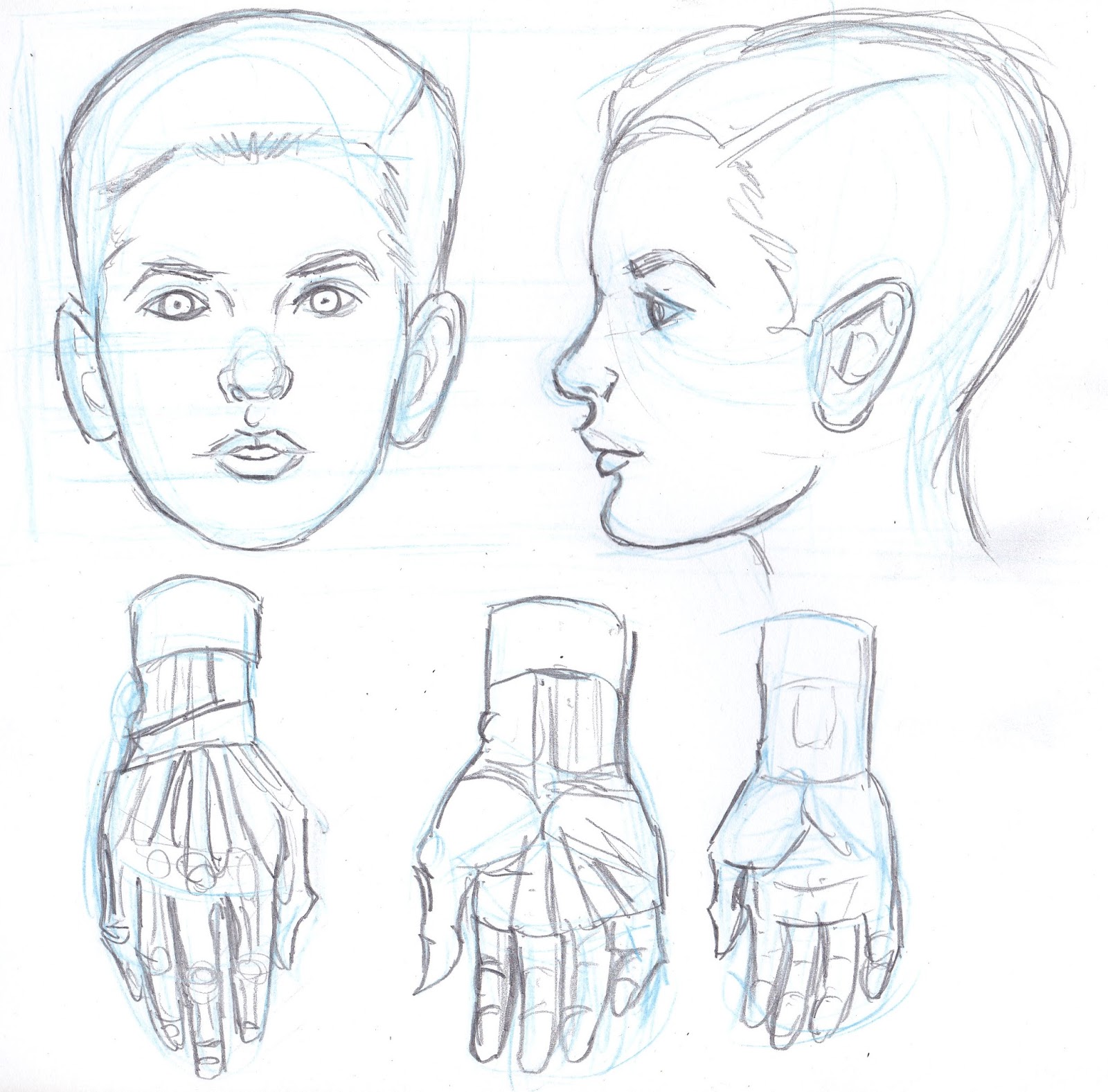
Recently I came across free PDF downloads of Andrew Loomis' drawing books and decided to give them all a read. I have done a number of studies taken from "Figure Drawing for All It's Worth", "Fun With A Pencil" and "Drawing the Head and Hands". These books have helped refresh my knowledge of anatomy and gesture, plus made me consider perspective, proportion and construction on a deeper level.


Tuesday, 14 March 2017

Less is More.

Below are miscellaneous doodles that I have done for fun.
 
 
I did this flamingo study in order to understand rendering feathers better.


With this fox photograph study, I have learnt that adding a noise layer to the fur gives it an extra level of believability. This is because each individual hair has scales on it, which do give each hair its own micro-texture.


 Sketches taken from photos in "The Natural History Book".
 
 
It might seem like I am being very productive with this module, though I realise that the opposite is starting to happen. In trying to study as much as possible, I am actually learning very little and am losing interest in drawing as a whole. Therefore, I am going to start limiting the amount of work that I do and start bringing this part of the module to a conclusion in preparation for making the final book.

Friday, 10 March 2017

GG species - Sea fury.

 
Before I get into the main meat of this post, here are some miscellaneous drawings I did to practise my drawing ability.


 The creature I have designed this time around is called a sea fury, or a sea phoenix. Before I drew his final design, I first did some sketches of birds from "The Natural History Book".
 I also drew from some references on Google.


Then I came up with a draft design for the sea fury. I've based the plumage on the design of Roman helmets. I plan on eventually coming back to this idea when I have a clearer idea of what I want the sea fury to look like.


Tuesday, 7 March 2017

The unicorn girl - Learning demonstration.

Following up from my last post relating to Terryl Whitlatch, I've decided to try and incorporate my new method to learning creature design. This method should minimize the amount of work I do while maximising learning.
 
I want to create a drawing called "The unicorn girl" which focuses on an anthropomorphic unicorn-girl child in a magical forest. I begin by throwing down a very quick design of my general idea. The initial concept is okay, but lacking in anatomical accuracy and the pose is a little awkward.
 
 
I will need to consult references in order to bring the design up to scratch. Instead of just bringing up photos to look at and re-design the girl, I will draw what I plan to use to load this into my visual memory so it is easier to recall the information later when I cannot pull up a reference. I also consult Terryl Whitlatch's work again for anatomical references as well as work from "The Ressurectionist" to give me a different angle on how to go about drawing fantasy creatures. I then consult Google images to bring up further references to fill in the gaps, but I will only draw as much as necessary to prevent wasting time and overloading my memory.


Now that I have references, I can start re-designing the character. I use Ken Hultgren's "The Art of Animal Drawing" to help me understand better how to get good, strong poses. I can explore the character as much as I want until I feel happy with it. I try and understand what her "appeal" needs to be. This is one of the 12 principles of animation, trying to give a character a certain "appeal". I figure that her appeal is that she is cute, shy and a little naïve. Next I lay out thumbnail sketches for potential compositions and pick the strongest one.


Now it's show time. I begin with a giant image, several thousand pixels in height and width. I will probably consult further references to give me a general idea of what kind of lighting and shading I would like to go for, but I won't use these too much so not to flat-out copy the images.
 
 
And there we have it! A finished image of the unicorn girl. I have finished an image while actively learning anatomy and character design at the same time. This is how I plan to carry out my studies rom now on, though with some variations to my study here and there when I want to be more spontaneous.
 

Monday, 6 March 2017

Coming to the final concept.


Recently, I received another haul of books for this (and other) projects. These include;
 
  • Anatomy for 3D artists - The essential guide for CG professionals.
  • The Goblins of Labyrinth.
  • Faeries
  • Animals Real and Imagined
  • The Art of The Last Guardian
  • How to Render. The Fundamentals of Light, Shadow and Reflectivity.
I may be referring to each of these books as I use them throughout my studies.
 
In the meantime, I have developed further thoughts on what I should do for my project. One of my issues is that I haven't been able to figure out to what scope I am doing this book. Though I would like to do as many creatures as possible, I do not want this book to unintentionally limit the story by giving a finite number of creatures that the characters will find, and there are also a number of creatures that I do not want to include yet because they are concepts that I am either going to omit entirely or work further into at a later date. Therefore, I have come up with two ideas for the book title that fits into the story context. These are;
 
  • Creatures of Upshire. The entire story tends to take place in the county of Upshire (which is the GG universe counterpart to Yorkshire). Upshire has a much more extreme landscape, particularly with Upshire valley which is a limestone gorge roughly the size of the Grand Canyon and a stone stack in the middle called "Precarious Rock". It also houses the largest forest in the country, Darkling forest. However, I still haven't figured out all of the locations of Upshire so I may give this one some consideration.
  • Creatures of Darkling forest. This is the aforementioned forest that is rich in its diversity of hidden ones. This is due to the fact that all of the creatures want to stick close to Poig, the resident forest spirit, thus creating a "hotspot" of forest magic. Most of the story takes place in and around this forest, so it makes sense to have a journal written from Gretchen's point of view accounting her experiences with each of the creatures. My only issue is that quite a large number of creatures may be omitted from the book and narrowing the scope too much.
Whichever idea I go with, the scope is at least starting to narrow a little more and my ideas have more clarity. What I really need to start doing now is study zbrush as I haven't yet done anything for this.
 
To finish off, I have done several sketches which I did to loosen up before working.


Friday, 3 March 2017

GG species - Chidderin.

From what I've learnt about goats when researching for fauns, I managed to use some of this knowledge to develop yet another one of my concepts - the chidderin. They are based heavily on mountain goats, squirrels and even have traits from geckos and spiders. They are intended to be some of the best climbers in the world and live on sheer cliff faces, often seen running up and down the vertical surface without any issues. Their feet are more unguligrade, though they have three toes like a tapir. Their long tail fur is tipped with millions of tiny hooks which can be used for extra grip, or the tail can be used to protect them from predators since predators cannot bite the tail as they risk getting the hairs caught in their throat and consequently choking. Chidderin don't make a lot of noise, only a soft cooing when danger is close which can sound a little like soft sobbing to a human. Their eyes have a horizontally slit pupil like most unguligrades and therefore they tend to see more into the blue side of the colour spectrum. If they fall off the cliff, their tail can be puffed out to form a sort-of rudimentary parachute or it can curl around the chidderin to brace them for the coming impact.